
Our capabilities
Comparative analytical characterization & process development
Comparative Analytical Characterization
Comparative analytical characterization is the scientific foundation of a proposed biosimilar development program. Its purpose is to evaluate how a proposed product compares with the designated reference product across quality attributes relevant to molecular identity, biological function, purity, stability, and potential clinical performance.
The analytical strategy should be molecule-specific, risk-based, and supported by sensitive and scientifically appropriate methods, using orthogonal methods where possible.
For proteins produced in mammalian-cell bioreactors, characterization also considers how cell-culture conditions, downstream purification, formulation, and storage may influence product quality attributes.
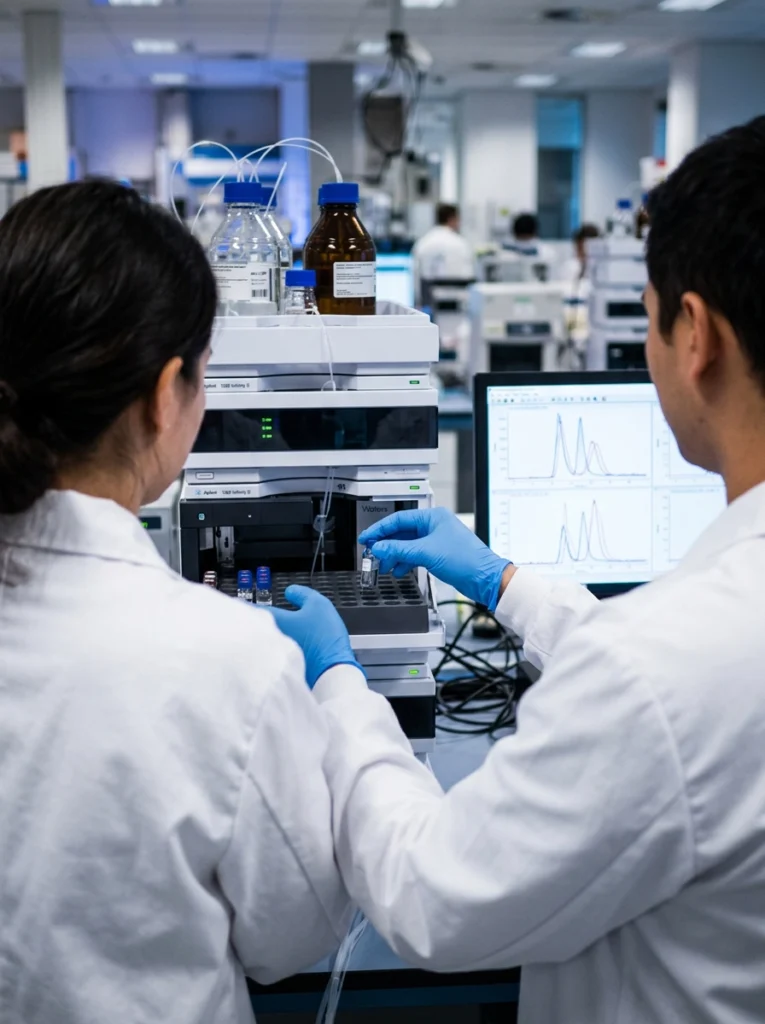
Intended Characterization Framework
- Prospective Quality Target Product Profile & risk-based CQA framework
- Justified sourcing & testing of reference-product lots
- Molecular identity & primary-structure assessment
- Higher-order-structure assessment
- Glycosylation & post-translational modifications
- Charge, size, aggregate & impurity evaluation
- Process-related impurity assessment (HCP, DNA, Protein A)
- Immunochemical & functional characterization
- Formulation & stress/forced-degradation studies
- Bioreactor–downstream–quality relationship studies
- Risk comparison of proposed vs. reference-product data
- Totality-of-Evidence Statement
These activities describe an intended research and development framework. They do not represent completion of any particular study, successful demonstration of biosimilarity, regulatory approval, or an established safety or efficacy profile.
A conclusion of high analytical similarity is based on the totality of the analytical data, not a single assay result. Depending on findings, further analytical work or additional nonclinical/clinical studies may be required.
Process Development
Mammalian-cell bioreactor platform
Upstream Development
Our upstream-development framework is intended for recombinant proteins produced in mammalian-cell culture. Activities are stage-appropriate and are designed to build process and product understanding for future development decisions.
- Screen production cell clones using growth, productivity, product-quality and stability criteria.
- Generate and cryopreserve research cell banks; establish a future MCB/WCB strategy.
- Develop seed-train and fed-batch mammalian-cell culture processes using bioreactor systems.
- Screen basal media, feeds and supplements; optimize feeding strategies.
- Evaluate process parameters and material attributes (pH, DO, temperature, agitation, etc.).
- Study process-parameter/CQA relationships to guide targeted optimization.
- Develop scale-up and scale-down strategies.
- Establish fit-for-purpose small-scale models and transfer-ready documentation.
Downstream Development
- Develop clarification, capture, intermediate purification and polishing operations using molecule-appropriate chromatography and filtration technologies.
- Develop tangential-flow filtration and ultrafiltration/diafiltration operations for concentration and buffer exchange.
- Optimize individual steps by balancing recovery, impurity clearance, product-related variants, aggregate control, throughput and process practicality.
- Design a complementary viral-safety strategy including virus inactivation and virus-removal filtration, supported by risk assessment.
- Perform scale-down and process-characterization studies to support future formal viral-clearance and validation work.
- Evaluate resin reuse and lifetime, hold times, intermediate stability and relevant operating ranges.
- Develop scale-up criteria and transfer-ready documentation for engineering confirmation.
Formulation Development
- Define a formulation-development strategy informed by the intended product profile, route of administration, concentration, presentation and molecule-specific risks.
- Screen buffers, pH, ionic strength, tonicity agents, stabilizers and surfactants using scientifically justified ranges.
- Use accelerated, stress and forced-degradation studies (thermal, oxidative, light, agitation, freeze-thaw) to investigate degradation pathways.
- Evaluate physical and chemical stability, including appearance, viscosity, aggregation, fragmentation, oxidation, deamidation, charge variation, particles and potency.
- Assess compatibility with processing steps and the intended container-closure system and administration conditions.
- Use long-term and accelerated stability data to support formulation selection and future shelf-life development.